
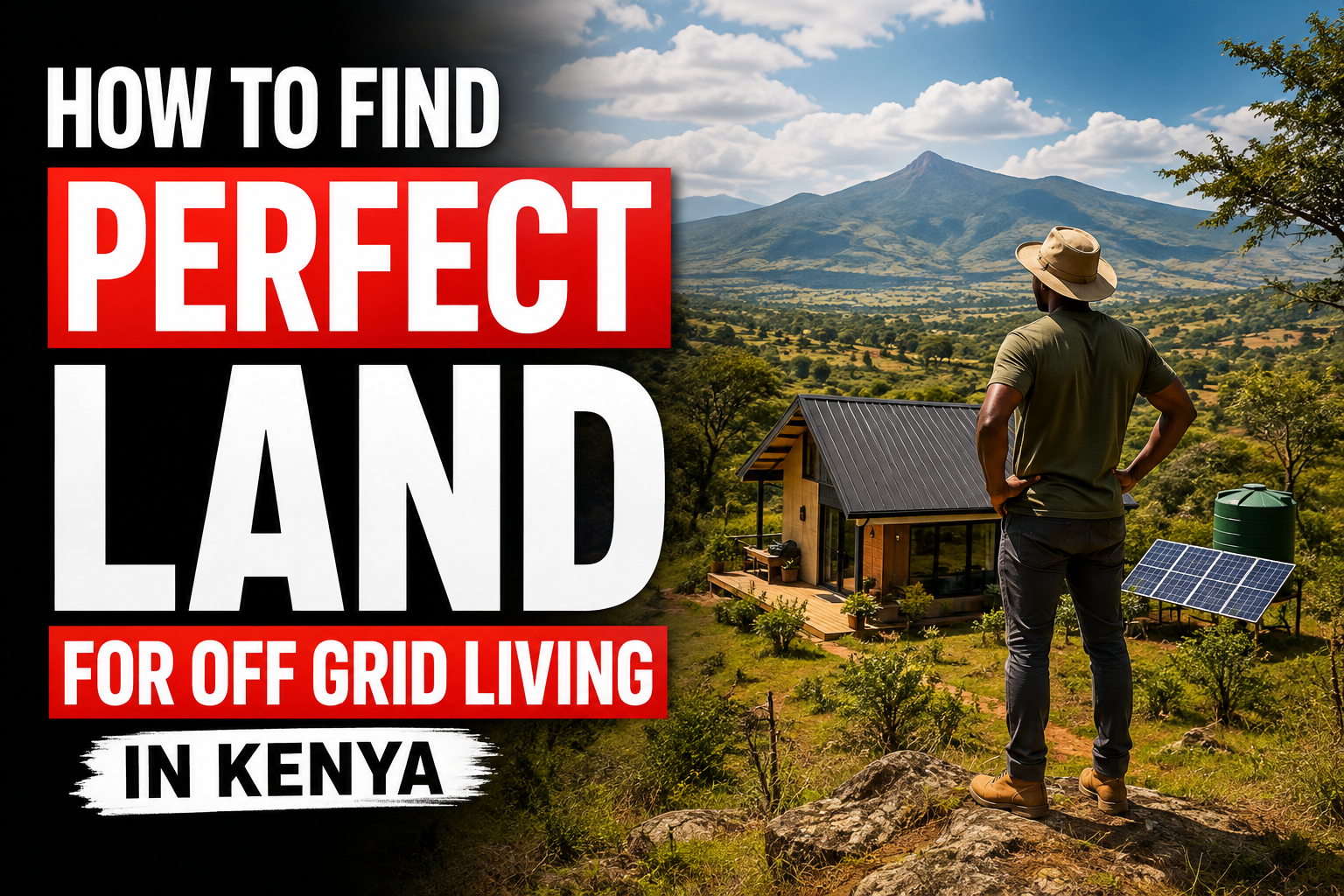
Off-grid living is becoming increasingly attractive in Kenya.
For some people, it means escaping the congestion of Nairobi and having more space. For others, it means growing their own food, generating their own electricity, having greater privacy, or simply creating a quieter and more self-sufficient lifestyle.
But there is one problem that many people overlook:
Finding the right land.
The perfect off-grid property is not necessarily the cheapest piece of land you can find. In fact, cheap land can become incredibly expensive once you start trying to make it livable.
If you are considering buying land for an off-grid home, farm, holiday property or lifestyle investment, here are some of the most important things you need to consider.
What Is Off-Grid Living?
Off-grid living generally means living in a property that is not dependent, or is minimally dependent, on conventional public infrastructure.
Instead of relying entirely on the electricity grid, you might generate your own power through solar.
Instead of relying on a municipal water supply, you might use a borehole, well, rainwater harvesting or another water source.
You may also have your own wastewater system, such as a septic system or biodigester, and potentially grow some of your own food.
The goal is greater self-sufficiency.
This is one reason off-grid living is becoming increasingly appealing in Kenya. People are looking for more space, privacy and a quieter lifestyle, while others want to work remotely, farm, keep animals or create a retreat away from the city.
But the success of that lifestyle starts with the land.
Don’t Start by Looking for Land
One of the biggest mistakes prospective buyers make is immediately going online and searching for the cheapest plots available.
Instead, start with two things:
Your budget and your location.
Your budget should not only include the purchase price of the land.
You also need to consider:
- Site preparation
- Construction
- Solar installation
- Water supply
- Borehole drilling, where appropriate
- Water storage
- Fencing
- Access roads
- Septic systems or biodigesters
- Internet connectivity
- Construction materials and transportation
A piece of land costing KSh 300,000 might initially look like an incredible bargain.
But what happens if the road is poor, water is difficult to access, the terrain requires extensive preparation and getting construction materials there costs a fortune?
The purchase price is only one part of the equation.
The real question is: what will it cost to turn that land into the life you want?
Start With the County You Know
When looking for land for off-grid living, one of the most overlooked options may be your own county.
There are obvious advantages.
You may already understand:
- The terrain
- The climate
- The local communities
- The roads
- Where water tends to be available
- Which areas are agriculturally productive
- Which areas experience flooding or other environmental challenges
You may also speak the local language.
That can be a significant advantage when you plan to live in a rural or semi-rural community.
Kenya is diverse, and local knowledge matters. Being able to communicate with the surrounding community and understand the local culture can make it easier to settle, build relationships and navigate life in the area.
So before looking hundreds of kilometres away, ask yourself:
Could my ideal off-grid property actually be in the county I already know?
If not, there are several other parts of Kenya worth considering.
Kajiado: Affordable Land Close to Nairobi
Kajiado is one of the areas worth considering if you want a more rural lifestyle without completely disconnecting yourself from Nairobi.
Its biggest advantage is proximity.
You can find larger parcels of land and still remain within reasonable reach of Nairobi, depending on the exact location.
Areas such as Kisaju and parts of the wider Kajiado region can offer relatively affordable land compared with many areas closer to Nairobi.
But there is one issue you should investigate very carefully:
Water
Do not buy land in Kajiado simply because someone tells you that there is water in the area.
A borehole may be working today. A well may have water today. That does not automatically mean that your particular property has a reliable long-term water supply.
Before buying, investigate the water situation carefully.
For an off-grid property, water is not a luxury.
It is one of the foundations of the entire project.
Machakos: A Balance Between Rural Living and Nairobi
Machakos offers another interesting option for people who want more space while remaining relatively close to Nairobi.
Depending on the location, you can potentially find larger parcels of land at more affordable prices than in areas immediately surrounding Nairobi.
The appeal is the possibility of having:
- More space
- Greater privacy
- Agricultural potential
- A rural environment
- Access to Nairobi when necessary
But once again, don’t evaluate land purely on price.
Look at the specific location.
Consider the road, terrain, water availability, soil, surrounding development and future potential.
Remember that you are not just buying a piece of land.
You are buying into a location.
Laikipia and Nanyuki: Lifestyle and Opportunity
Laikipia is particularly attractive for people looking for beautiful landscapes, larger parcels and a different kind of lifestyle.
The area around Nanyuki is also interesting because it provides access to a relatively developed and cosmopolitan centre.
This creates an interesting combination.
You can have a rural or semi-rural property while still having access to shops, restaurants, services and other amenities.
There is also potential for some properties to become income-generating assets.
For example, if you build the right type of property in the right location, you may eventually have the option of using it as a short-term rental when you are not occupying it.
However, Laikipia should not be treated as one uniform market.
Security and other conditions can vary significantly between locations, so you need to understand the specific area before buying.
Kitui: When You Want Space
If your dream is to have a very large piece of land rather than simply an acre or two, Kitui can offer some interesting possibilities.
In some areas, you can find very large parcels at prices that would be difficult to achieve closer to Nairobi.
You could potentially acquire a substantial piece of land for less than you might spend on a much smaller property in more developed areas.
But there is a trade-off:
Distance.
For someone based in Nairobi, travelling to some parts of Kitui can take significant time.
That means your property search needs to be planned properly.
You may have to spend a night in the area when viewing properties rather than attempting to make a quick day trip.
This is actually important when buying rural land.
You should not visit a property once, fall in love with the scenery and immediately pay a deposit.
Take your time.
Talk to people.
Understand the area.
Visit more than once where possible.
And conduct proper due diligence before committing your money.
What About Kiambu?
If you want genuine off-grid living, most parts of Kiambu would probably not be the first place to look.
Much of Kiambu is already highly developed and closely connected to Nairobi.
You have established roads, electricity, businesses and other infrastructure.
That makes it less suitable if your primary goal is to completely disconnect from conventional infrastructure.
However, there are still areas where you can find larger pieces of land and create a more private, semi-rural lifestyle.
Areas such as Nguirubi can offer opportunities, although the prices are significantly different from some of the more distant counties.
You may find an acre from around KSh 2 million, depending on the exact location and characteristics of the property.
So Kiambu can work for some buyers.
But if your goal is a truly off-grid lifestyle, you may need to look further away from Nairobi.
The Coast: Cheap Land With Important Caveats
The Coast presents a completely different proposition.
Parts of Kilifi and Malindi can still offer land at prices that look extremely attractive compared with Nairobi and its surrounding counties.
In some locations, you may come across land advertised from around KSh 100,000 per acre, while large parcels may also be available.
That can make the Coast extremely tempting.
But this is where you need to remember:
Cheap land isn’t necessarily cheap land.
Accessibility can be a problem in some locations.
And perhaps more importantly, buyers need to be extremely careful with land documentation and ownership.
Coastal Kenya has a long history of complicated land ownership issues. That means proper due diligence is particularly important.
Do not allow an attractive price to pressure you into rushing the purchase.
At the same time, the Coast has advantages for off-grid living.
Some areas can offer relatively easy access to water compared with certain dry parts of inland Kenya.
The climate and landscape also create opportunities for a very different kind of lifestyle property.
As always, it comes down to understanding the trade-offs.
Don’t Forget to Check the Soil
When people talk about buying land, they often focus on the title, price and location.
For off-grid living, soil should also be part of the conversation.
Why?
Because soil affects much more than farming.
If you plan to grow your own food, soil quality obviously matters.
But soil can also influence:
- Drainage
- Site preparation
- Construction
- Foundation requirements
- Wastewater systems
- Septic system or biodigester suitability
Two pieces of land can look almost identical from the surface but have very different conditions underneath.
You therefore need to understand what you are actually buying.
You aren’t just buying the land you can see. You’re buying the ground underneath your future life.
Water Needs Serious Investigation
Water deserves special attention because it can make or break an off-grid property.
Do not rely solely on what the seller tells you.
Do not assume that because a neighbouring property has a borehole, yours will automatically have reliable water.
Depending on the location, you may need to investigate:
- Borehole potential
- Existing wells
- Groundwater
- Rainfall
- Rainwater harvesting
- Water storage
- Water quality
- Seasonal changes in water availability
In some areas, a water source may appear reliable but become problematic during dry periods.
A proper assessment before purchasing can save you from a very expensive mistake later.
Remember That Off-Grid Does Not Mean Isolated From Everything
There is another side to off-grid living that is often ignored.
When you move further into rural areas, you are also moving closer to nature.
That means you need to understand the environment.
In some areas, including parts of the Coast and Kitui, snakes and other wildlife are part of the environment you may encounter.
This is not necessarily a reason to avoid those areas.
It is simply something to understand and prepare for.
The same applies to security and the surrounding community.
Your dream off-grid property should be somewhere you can actually live comfortably and safely.
So, Where Should You Buy Land for Off-Grid Living in Kenya?
There is no single answer.
The right location depends on the kind of life you want to build.
If you already understand a particular county and have family or community connections there, start there.
If you want to remain relatively close to Nairobi, consider areas in Kajiado and Machakos.
If you want beautiful landscapes, larger parcels and access to a more cosmopolitan centre, Laikipia and Nanyuki are worth considering.
If you want very large pieces of land and are comfortable travelling further from Nairobi, Kitui may offer interesting opportunities.
If you want to explore the Coast, Kilifi and Malindi can offer attractive land prices, but accessibility and land documentation require serious attention.
And if you want something closer to Nairobi with more established infrastructure, parts of Kiambu may work, although you will generally be paying more.
Ultimately, the perfect off-grid property is not the one with the lowest price per acre.
It is the property where the land, water, soil, access, security, community, climate and budget all make sense together.
Planning to Buy Land in the Next 6–12 Months?
Finding land is easy.
Finding the right land is the real work.
If you are planning to buy land in the next six to twelve months and you want guidance through the process, our team can help you.
We can help you identify suitable locations, find properties that match your requirements, evaluate the opportunities and guide you through the buying process.
Before you commit your money, you should understand exactly what you are buying and why you are buying it.
If you would like help finding your ideal off-grid property in Kenya, contact our team for a free consultation using the number provided on this website.
Tell us about your budget, preferred location and the kind of lifestyle you want to build, and we can discuss how best to support you.
Your dream off-grid lifestyle starts with choosing the right piece of land.
